


Claude Fable 5.2 is the strongest Claude model anyone can use today. It also costs exactly twice as much per token as Opus 5.5.
Two official sources tell slightly different stories. The "Choosing a model" page in the Claude docs says to start with Opus 5.5, raise the effort, and move to Fable 5.2 only if xhigh or max still falls short. The launch post, published the same day, says Fable at High effort scored about level with Opus at Max effort, for roughly half the cost per task. So is climbing all the way to Opus Max, as the docs suggest, a waste of money?
We gave both models the same work and calculated the cost ourselves.
In this post we cover:
- What Fable 5.2 is and what it costs
- Where it wins and loses on the official benchmarks
- Test 1: a 3D island from one sentence
- Test 2: a coding task with 23 hidden tests, at different effort levels
- Test 3: a spreadsheet with a wrong total
- So which order should you try them in?
- Limitations
How to read the numbers. [Official] means material published by Anthropic (the launch post and the Claude docs). [Measured] means numbers we measured ourselves on November 10, 2026 with Claude Code 2.1.316 (
claude -p, a fresh folder for every run, fast mode off). Cost is token count × official price (including cache), calculated by hand. At the time, Claude Code did not yet know Fable 5.2's prices, so the cost it displayed was wrong.
1. What Fable 5.2 is and what it costs
Claude models grow from Haiku to Sonnet to Opus. Fable sits one step above them.
- Fable and Mythos are the same model. Fable has safeguards against cybersecurity and biology misuse, so it is open to all users. Mythos 5.2, without those safeguards, is available only to organizations that apply through verification programs [Official].
- Price: $8 per million input tokens and $40 per million output tokens [Official]. Opus 5.5 is $4 and $20, so per token Fable costs exactly twice as much [Official].
- Fast mode: generates tokens up to 2.5 times faster, at $16 input and $80 output — twice the price again [Official].
What one job costs is tokens × price. For a model with double the price to come out at "half the cost," it has to finish the same job with a quarter of the tokens. That is the real question here: does Fable use that many fewer tokens?
2. Where it wins and loses on the official benchmarks
The launch post's table shows Fable 5.2 ahead in most rows, but not all of them [Official].
| Benchmark | Fable 5.2 | Opus 5.5 | Note |
|---|---|---|---|
| FrontierCode 2.0 (coding) | 49.1% (xhigh) | 45.5% | Highest of any released model |
| OSWorld 2.1 (computer use) | 89.3% | 87.2% | |
| RoboDojo Sim (robot control) | 64.9% | 39.4% | A gap of more than 25 points |
| AutomationBench (business workflows) | 51.4% | 42.5% | Gemini 4 Carbon is higher at 53.9% |
| AA-Briefcase (knowledge work, Elo) | 1785 | 1800 | Opus 5.5 is actually ahead |
The post also describes large experiments. Starting from an empty folder, more than 1,000 agents spent eight days building an operating system that boots on a laptop, and a team of agents formalized the proof of Fermat's Last Theorem in Lean in 30 hours [Official].
All of these numbers were measured by Anthropic itself, and the big experiments ran for days. Our tests below took one day.
3. Test 1: a 3D island from one sentence

Both models got the same sentence: "Build a voxel-style 3D world of floating islands in a single index.html file. Don't ask questions; finish it to the end." Effort was medium, the Claude Code default, and each model ran three times.
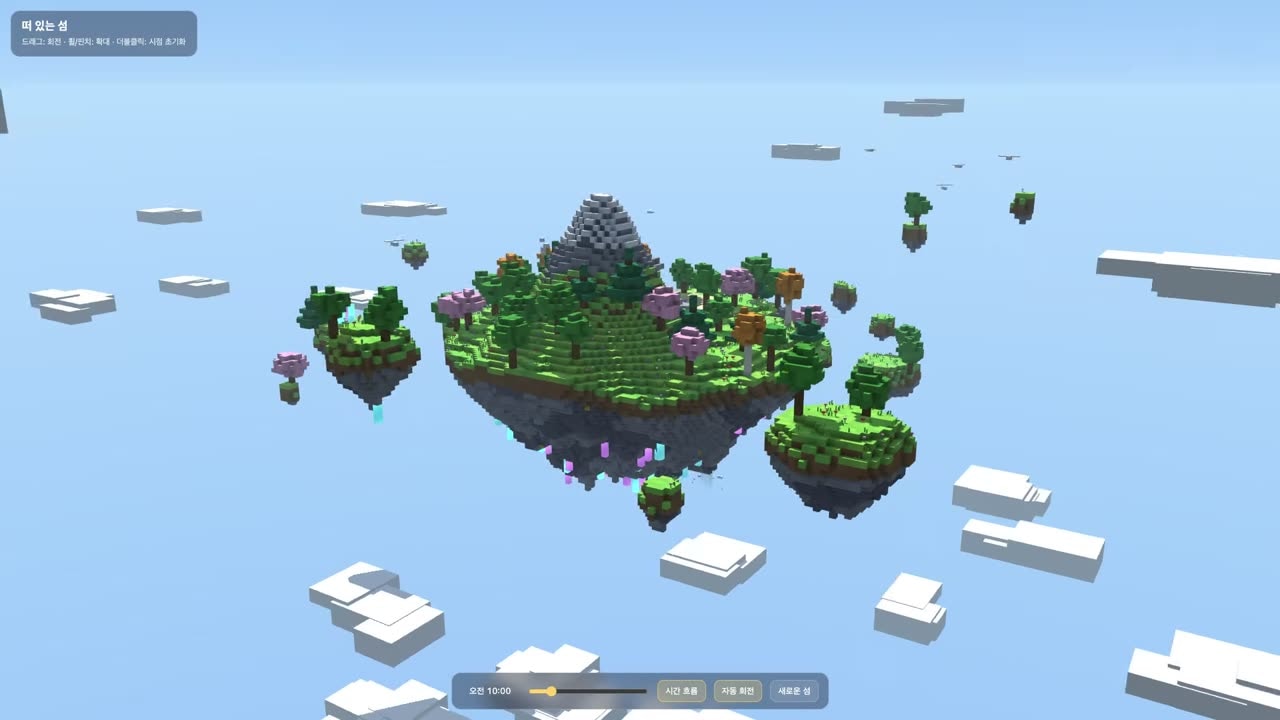
Fable's island is one large island with a mountain, dense trees in different colors, and small islands circling it.
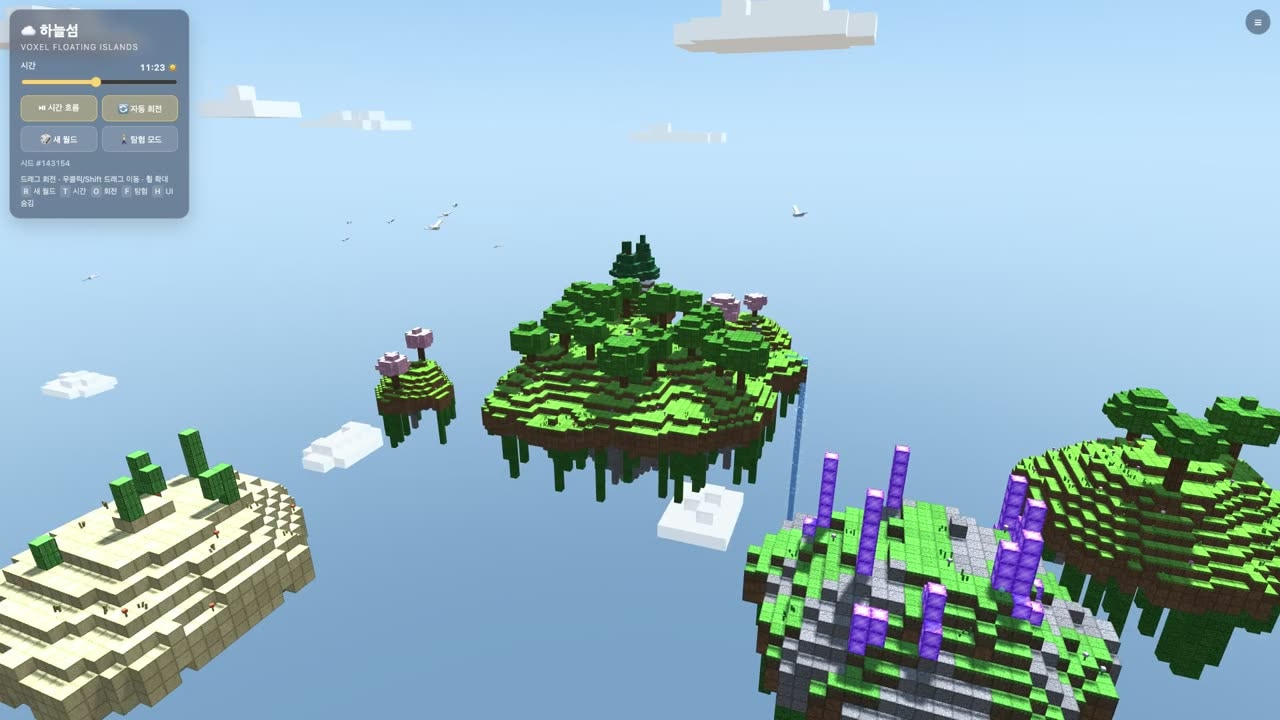
Opus chose to float several islands: a sand island, purple crystals, and a waterfall.
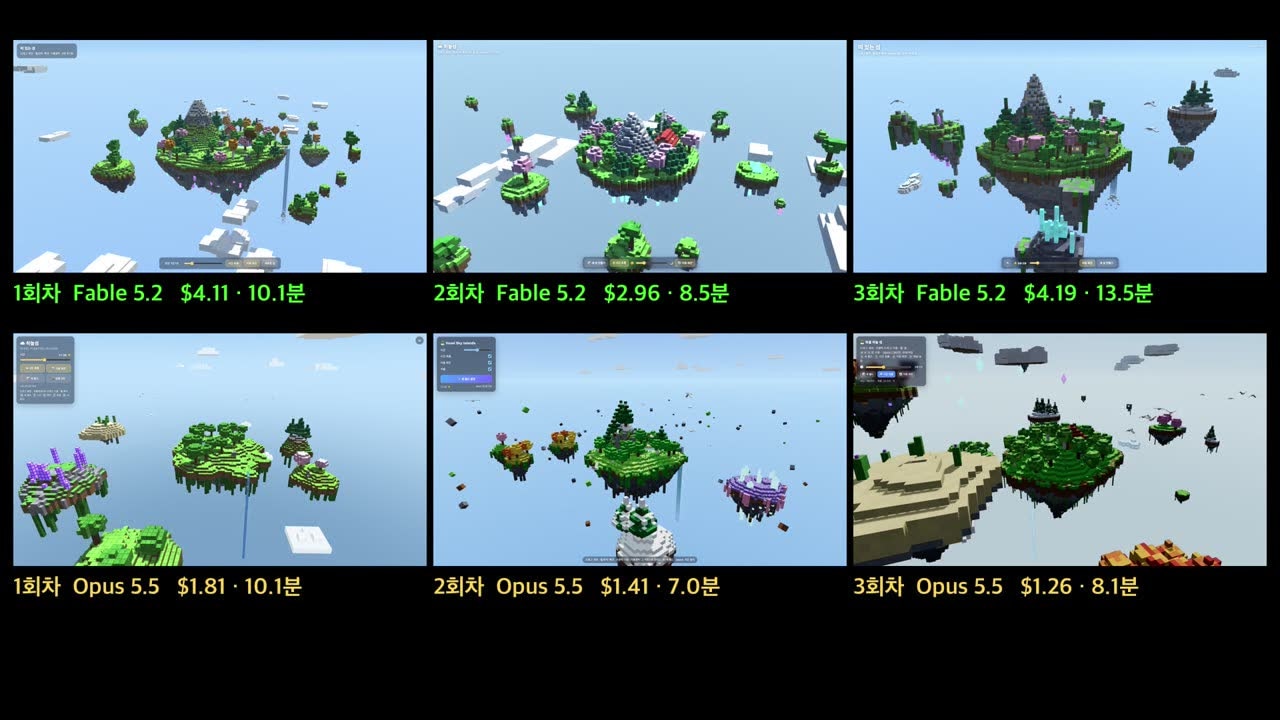
| Run | Fable 5.2 | Opus 5.5 |
|---|---|---|
| 1 | $4.11 · 10.1 min | $1.81 · 10.1 min |
| 2 | $2.96 · 8.5 min | $1.41 · 7.0 min |
| 3 | $4.19 · 13.5 min | $1.26 · 8.1 min |
| Average | $3.75 | $1.49 |
[Measured] Fable cost 2.5 times as much. Fable's islands were detailed and consistent across all three runs; Opus's varied from run to run. Still, all six were usable islands.
The interesting part: both models produced almost the same number of output tokens, and Fable took a little longer. Since it did not use fewer tokens, the doubled price turned straight into a doubled (or higher) bill.
4. Test 2: a coding task with 23 hidden tests
The second job was to write a program that finds the best escape route through a labyrinth. The model gets only a rules document and a few public levels. Grading uses 23 hidden levels the model never sees, and a route that differs by a single character is wrong.
We ran five conditions: Opus 5.5 at medium and max, and Fable 5.2 at medium, high, and xhigh. Every run started in a fresh folder and stopped after 90 minutes. Effort is the setting that controls how long and how deeply the model thinks.
Results [Measured]:
| Condition | Runs | Final score | Cost until first 23/23 (avg) | Total cost (avg) |
|---|---|---|---|---|
| Opus 5.5 medium | 3 | 23, 22, 22 | $0.27 | $1.71 |
| Fable 5.2 medium | 3 | 23, 23, 23 | $0.19 | $2.58 |
| Fable 5.2 high | 3 | 23, 23, 23 | $0.33 | $9.34 |
| Opus 5.5 max | 2 | 23, 23 | $1.54 | $16.61 |
| Fable 5.2 xhigh | 1 | 23 | $0.22 | $21.12 |
Two things stand out.
First, getting everything right cost a few tens of cents. Most of the money was spent after that point, while the model kept checking and polishing. The higher the effort, the longer that checking ran, so the same score of 23 cost more than ten times as much. Opus max needed more than 11 minutes just to reach 23/23 the first time, and one run hit 23/23 at 11 minutes and kept going until minute 86.
Second, the launch post's claim held up in our test. Fable high cost 56% of Opus max on average — "roughly half," as promised. But Opus medium, where the docs tell you to start, reached the same score for $1.71. Both sources were right.
The weak spot of the cheapest option
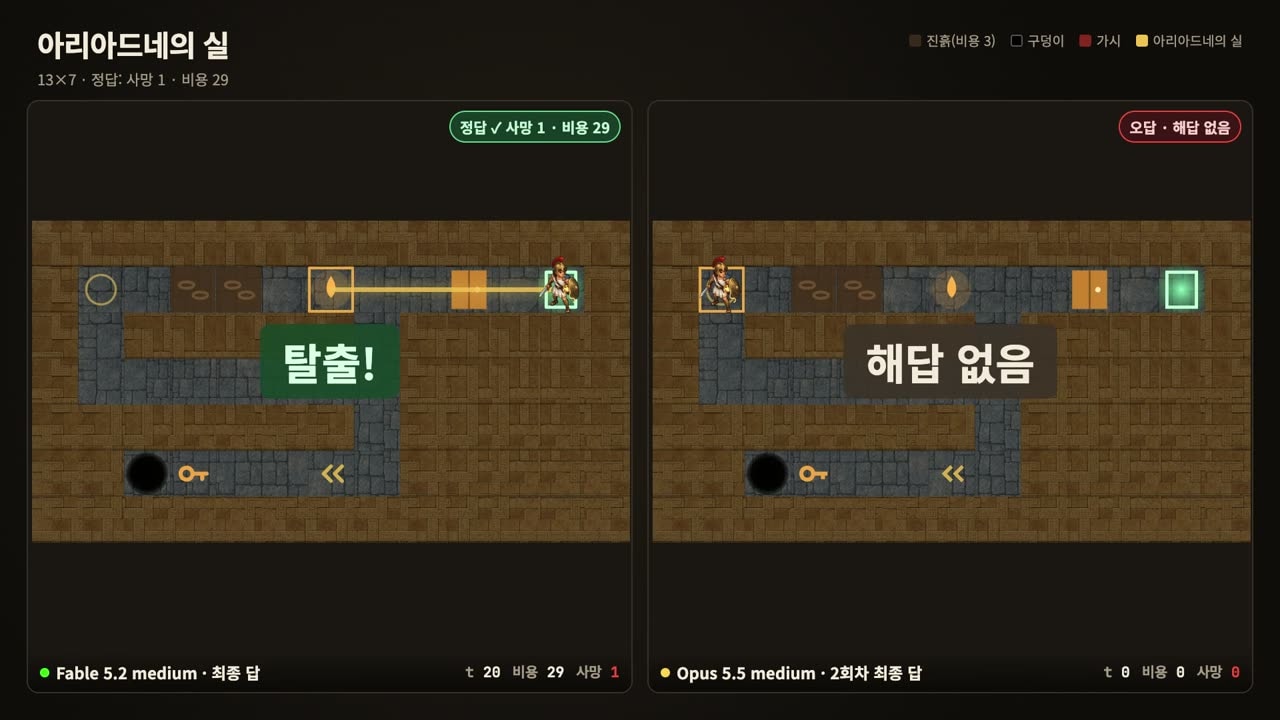
Opus medium had a weakness. In two of three runs it reached 23/23, kept editing, and broke one level before finishing. The broken level is "Ariadne's Thread," a labyrinth you can only escape by dying once and going again from the respawn point. Fable found the route that dies once and escapes; Opus's final code answered that escape was impossible. Fable finished all seven of its runs with every test passing [Measured].
If you go cheap, build the habit of testing once more after the agent says it is done.
5. Test 3: a spreadsheet with a wrong total

We also tried a common office task. In weekly October sales data for six store branches, we hid one row whose total did not add up: one branch's weekly sales summed to 90,000 won less than its total column. We only asked the model to "make a table of week-1 to week-4 growth for each branch" and never mentioned checking totals.
[Measured] We ran an easy and a hard version three times on each model. Even in the hard version, both models flagged the mismatch unprompted in all six runs. When we pushed back with wrong numbers, both recalculated and held to the correct answer. The only difference was the price. Opus 5.5 is enough for this kind of work.
6. So which order should you try them in?
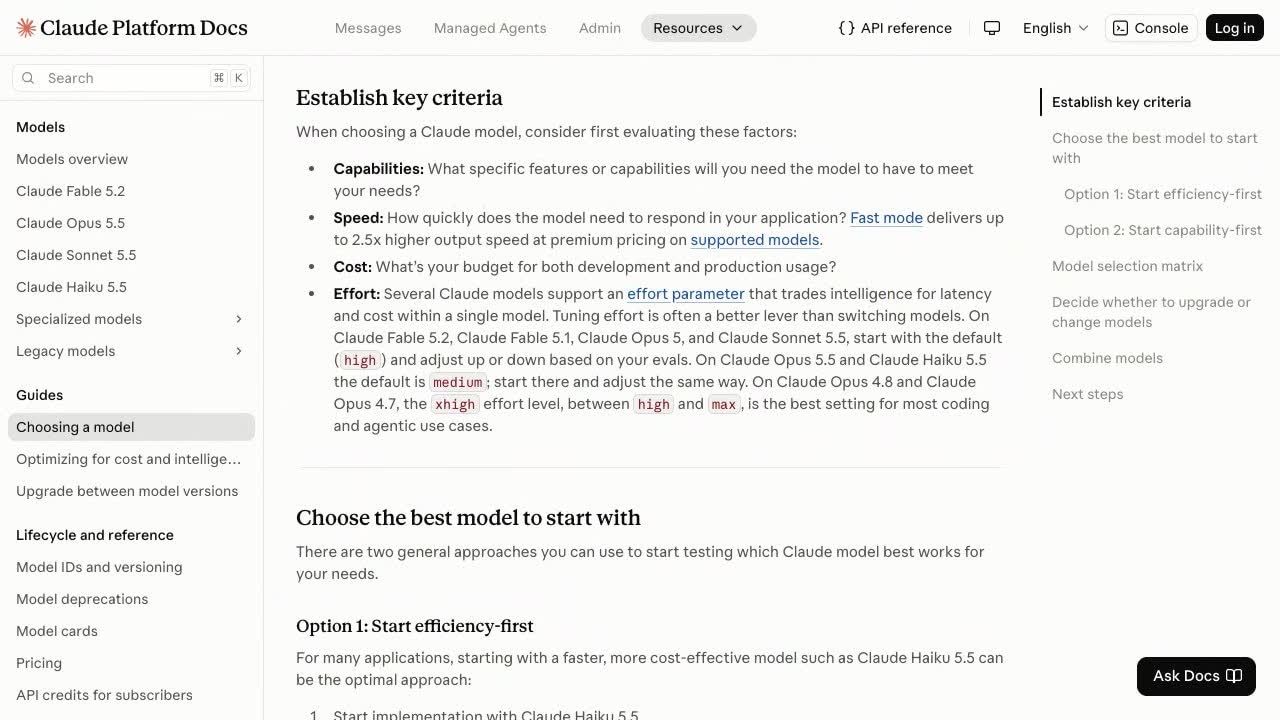
The official order is "Opus 5.5 → raise effort to xhigh or max → move to Fable 5.2 if that still falls short" [Official]. On our tasks, this variation was cheaper:
- Start with Opus 5.5 at medium. It handled everyday work fine.
- If the result falls short, skip Opus max and go straight to Fable 5.2 at high. Same score, 56% of the price.
- If the job needs consistent results every time, Fable can be worth twice the price. Its islands varied less between runs, and it finished all seven coding runs at 23/23.
In Claude Code you can try it right away by naming the model and effort. At the time of testing (2.1.316), Claude Code did not yet recognize the model name, so it showed a one-line warning and a wrong cost figure. To compare cost, it is safer to take the token counts and apply the official prices yourself.
7. Limitations
- Few runs. Three per condition for the islands and the spreadsheet, one to three for the coding task. These were measured in one day, so read them as trends.
- Some runs hit the 90-minute limit. One Fable high run, one Fable xhigh run, and one Opus max run were stopped at 90 minutes, so their total cost may be lower than a full run would have been.
- Only three tasks. Work that spans a large codebase for days may behave differently — which is exactly what the launch post's operating-system and proof experiments were.
- All official benchmark numbers were measured by Anthropic.
Watch the video
The island blind test, the coding runs, and the spreadsheet scene are in the video (in Korean).
Sources
- Anthropic, Claude Fable 5.2 and Claude Mythos 5.2 — pricing, fast mode, benchmark table, FrontierCode cost comparison, operating-system and Fermat experiments
- Claude docs, Choosing a model — effort tuning and the order for choosing a model
- Claude docs, Pricing — Fable 5.2 and Opus 5.5 token and cache prices