

One team handed over a single spec, waited four and a half hours, and came back to a finished voice assistant. They say Google's new model, Gemini 4 Carbon, built it on its own.
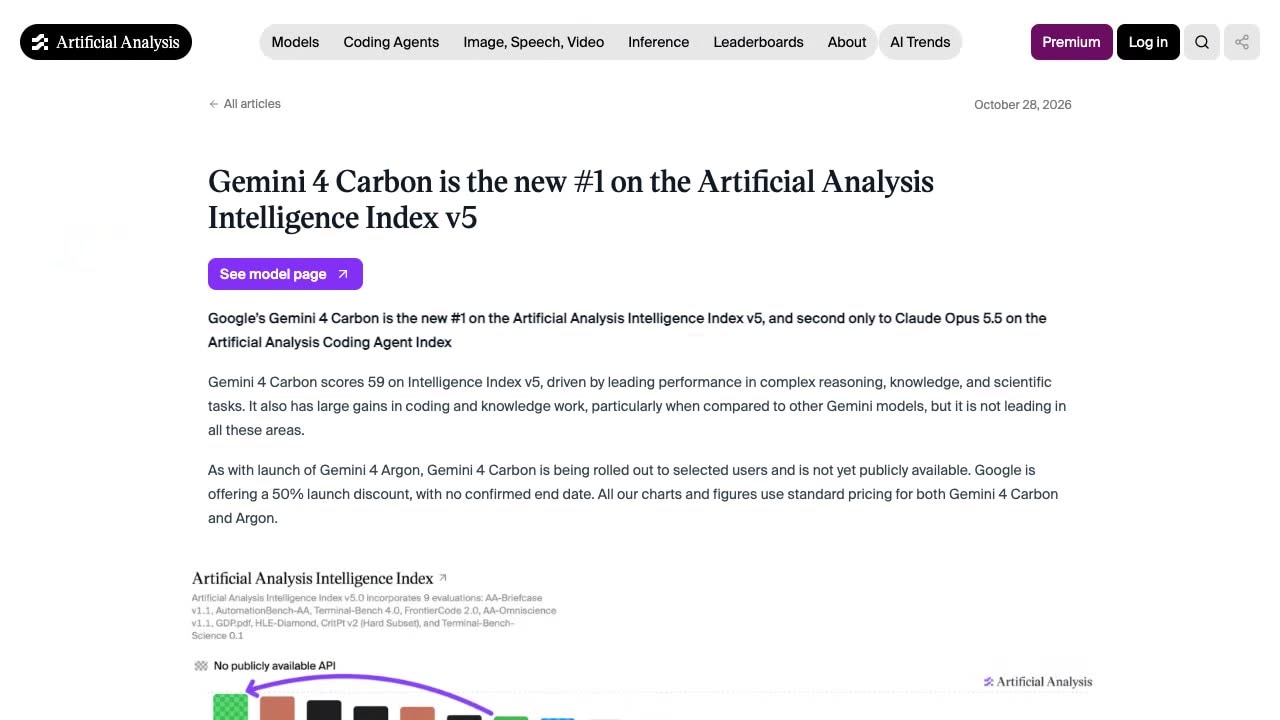
On its announcement day, October 28, Carbon ranked first on the Intelligence Index of the independent benchmark site Artificial Analysis. Its per-token price is half of Claude Fable 5.2's, and a quarter during the November launch pricing. Two weeks later, though, it had slipped to the fourth row of that leaderboard.
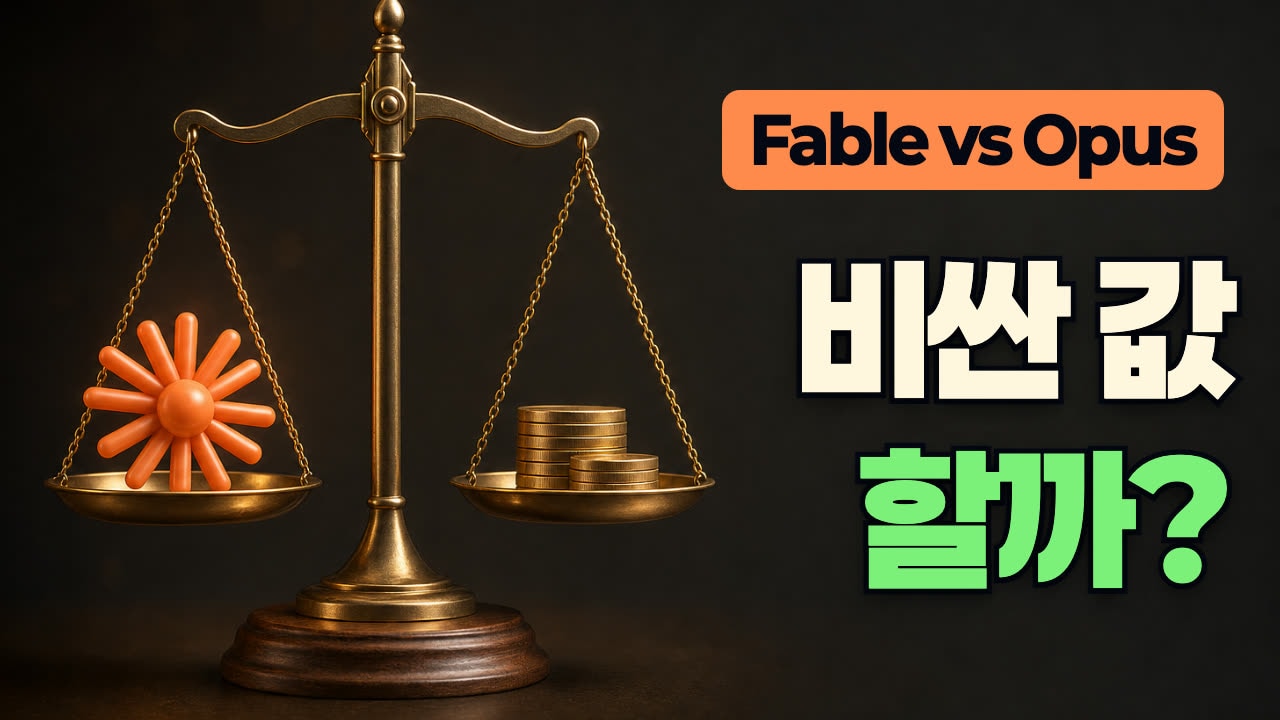
So there is one question worth asking. If the per-token price is half, is the cost of finishing a task also half?
In this post we cover, in order:
- What Carbon is
- What early testers built
- How it differs from Argon
- How it compares with rival models
- The real price: cost per task
- The weak spot: speed
- Which plan unlocks it
- How to choose, and limitations
How to read the numbers. [Official docs] means material Google published itself (blog posts, model card, safety report, price list). [Community report] means results published by someone other than Google (independent benchmark sites, developer channels and blogs) that we did not reproduce. [Our measurement] means a value we checked directly on our own account screen. All numbers are as of November 11, 2026, and leaderboards keep changing.
1. What Carbon is
Carbon is the top model in the Gemini 4 family [Official docs].
- Announced October 28. For the first two weeks it was open only to security defenders and partners (the Fairwind program), and it became generally available on November 10 [Official docs].
- Google says Carbon is tuned for two things: security and long-horizon work, meaning long tasks that run for hours or days without a human stepping in [Official docs].
- It spends more tokens than Argon to explore more deeply and verify repeatedly. Google itself writes that Argon, the model below it, is the right pick for most development and knowledge work [Official docs].
Google showed off results such as a 3D game of a pelican riding a bicycle and a 3D model of its office built from city council planning PDFs. These were made with a feature called swarm, where several agents split up a single request [Official docs]. Still, these are scenes Google picked to show. So next we look at what other people got when they ran it.
2. What early testers built
Everything below is what each channel or blog reported from its own runs. [Community report]
codeSTACKr: one spec, four and a half hours
- This was an early run on the side of LiveKit, a voice-service company. They gave Carbon a single spec (a PRD, product requirements document) and didn't touch it until it finished.
- About four and a half hours later, out came a voice assistant that opens documents by voice, finds a pricing PDF and fills in forms. Along the way, Carbon never stopped to ask a question.
- It enforced a human confirmation step in code before submitting, and wrote tests for it.
- They deliberately left out of the spec the problem of screen clicks missing their target, yet Carbon measured the offset and fixed it by resizing the screenshots itself.
The same channel also gave two real bugs to Carbon, Argon and Opus 5.5, describing only the symptoms.
| Task | Result |
|---|---|
| Bug 1 | All three found the same one-line fix. Carbon 68 min, Opus 5.5 15 min |
| Bug 2 | None of the three fully solved it |
| Security review | Only Carbon found the most serious framework bug, though it rated most of its findings as more severe than they really were |
Sam Witteveen: a 3D building and a Mac app
- He asked for a 3D model of Marina Bay Sands in Singapore, deliberately choosing a building with less material online than the Eiffel Tower. It came out mostly in one shot, followed by two or three more prompts to add clouds and people.
- A short prompt starting with "Make the best Pomodoro Mac app" produced a native Mac app in Swift. (A Pomodoro timer tracks focused work sessions.) It even included a menu bar feature nobody asked for, and he downloaded the compiled app and ran it right away.
- He described Carbon as a model you "kick off and leave," and said he wouldn't use it for chat.
Paul J Lipsky: the same prompts, side by side with Argon
- He gave both models the same space-flight game prompt. He rated Carbon's version much cleaner, while Argon's was more crowded, its ship looked blockier, and the controls responded less well.
- When asked to draw with code only, Carbon's portrait of an old man was more detailed, but when redrawing his own photo, Argon's result looked much better. Asked why, Carbon replied that Argon had turned the original photo into a list of numbers inside the code, while Carbon drew with formulas only. That is Carbon's own explanation; the video doesn't say anyone checked the code.
- When given a video-editing job, Carbon took much longer than Opus 5.5 but finished in one go.
Bijan Bowen and Simon Willison
- Bijan Bowen had it build an entire operating system inside the browser and called the driving game inside it much better than Argon's. Argon's result isn't shown, though; that comparison is from memory. He said it "isn't fully at the level of the Claude models, but probably the closest a non-Claude model has gotten."
- Developer Simon Willison posted a pelican-on-a-bicycle drawing and a robot animation on his blog. The robot used the exact prompt he had given Fable 5.2 the day before, plus one follow-up.
Taken together, reviews were good for long tasks you leave running, while two channels said they would use a different model for chat or quick fixes.
3. How it differs from Argon
Its API price is identical to last month's Gemini 4 Argon, and both double on December 1 [Official docs].
| Item | Argon | Carbon | Type |
|---|---|---|---|
| 17 tests in the model card | Lower on all 17 | Higher on all 17 | [Official docs] |
| ExploitGym (security) | 42.0% | 54.8% | [Official docs] |
| Rate of reporting problems instead of hiding them | 70% | 92% | [Official docs] |
| ARC-AGI-3 (reasoning on unseen puzzles) | 49.8% | 65.1% | [Community report] ARC Prize |
| Arena Text (human votes) | 1522 | 1526 (preliminary) | [Community report] Arena |
| Output tokens | baseline | about 1.8× | [Community report] Artificial Analysis |
| Time to first answer | 39 s | 66 s | [Community report] Artificial Analysis |
| Hallucination rate (making things up) | 4% | 11% | [Community report] Artificial Analysis |
The 4-point gap on Arena is within the margin of error, and Carbon's score still carries a preliminary label. In exchange for the higher scores, it uses more tokens and more time, and hallucinates more. That doesn't automatically make it more expensive per task, though. In Vals AI's measurement, Carbon actually came out cheaper (section 5).
Argon also appears in Google's 94-page safety report. Google writes that Carbon showed no meaningful new capabilities over Argon, so it carried over Argon's capability evaluations and determinations. It also says it cannot rule out that, without safeguards outside the model, Carbon could reach the cyber and bio-information thresholds, so it strengthened cyber-misuse protections compared with Argon [Official docs].
4. How it compares with rival models
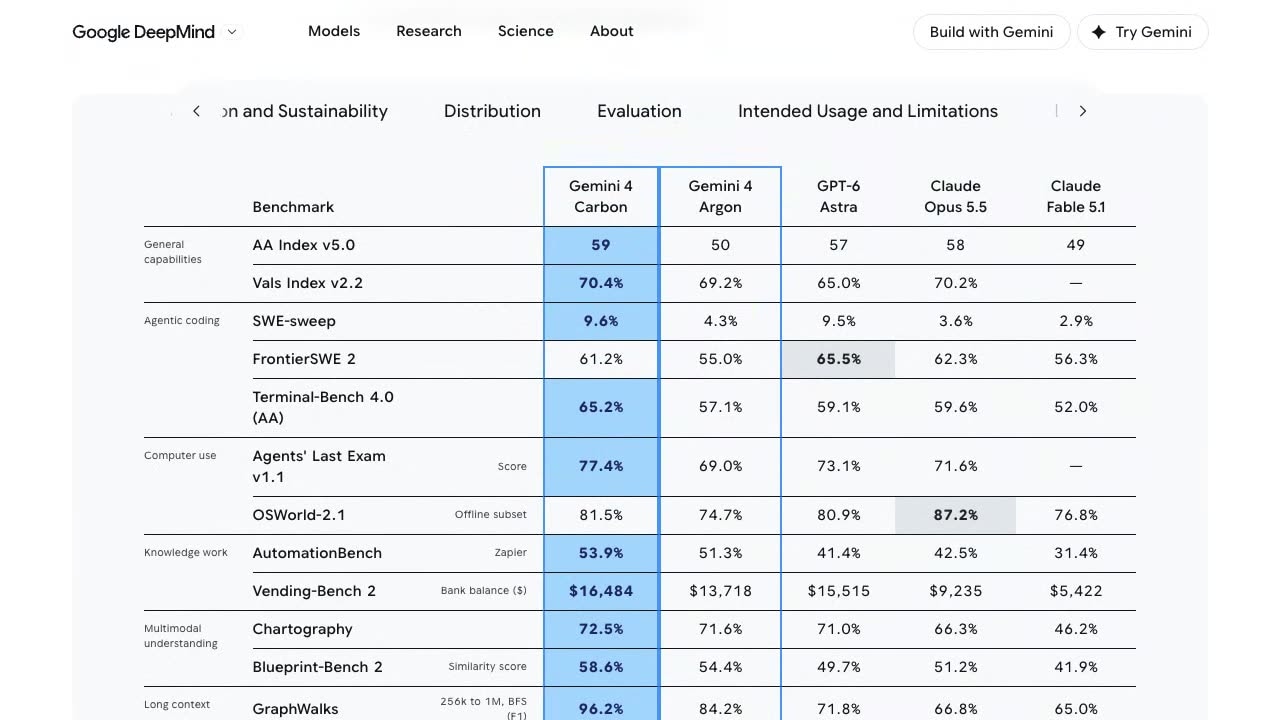
In Google's model card table, Carbon is highest on the long-context test (96.2%) and the work-automation test, AutomationBench (53.9%). On the other hand, it trails GPT-6 Astra on the coding test FrontierSWE 2 (61.2% vs 65.5%) and Opus 5.5 on the computer-use test OSWorld-2.1 (81.5% vs 87.2%) [Official docs].
But the Claude Fable in that table is 5.1, not 5.2, because the table dates from October. So we need independent measurements that include Fable 5.2. [Community report]
- Artificial Analysis Intelligence Index: Carbon scores 60, 4th of 74. The top three rows are all Fable 5.2 at different effort settings (how deeply it thinks), with the highest at 65. Counted per model, Carbon is second.
- Vals Index: Carbon is 3rd at 70.45%; Fable 5.2 is 1st at 71.31%.
- Arena WebDev: 1768, 4th (preliminary).
- ARC-AGI: On version 2, Carbon edges out Fable 5.2, 94.2% to 93.8%. On version 3, Fable leads, 81.2% to 65.1%.
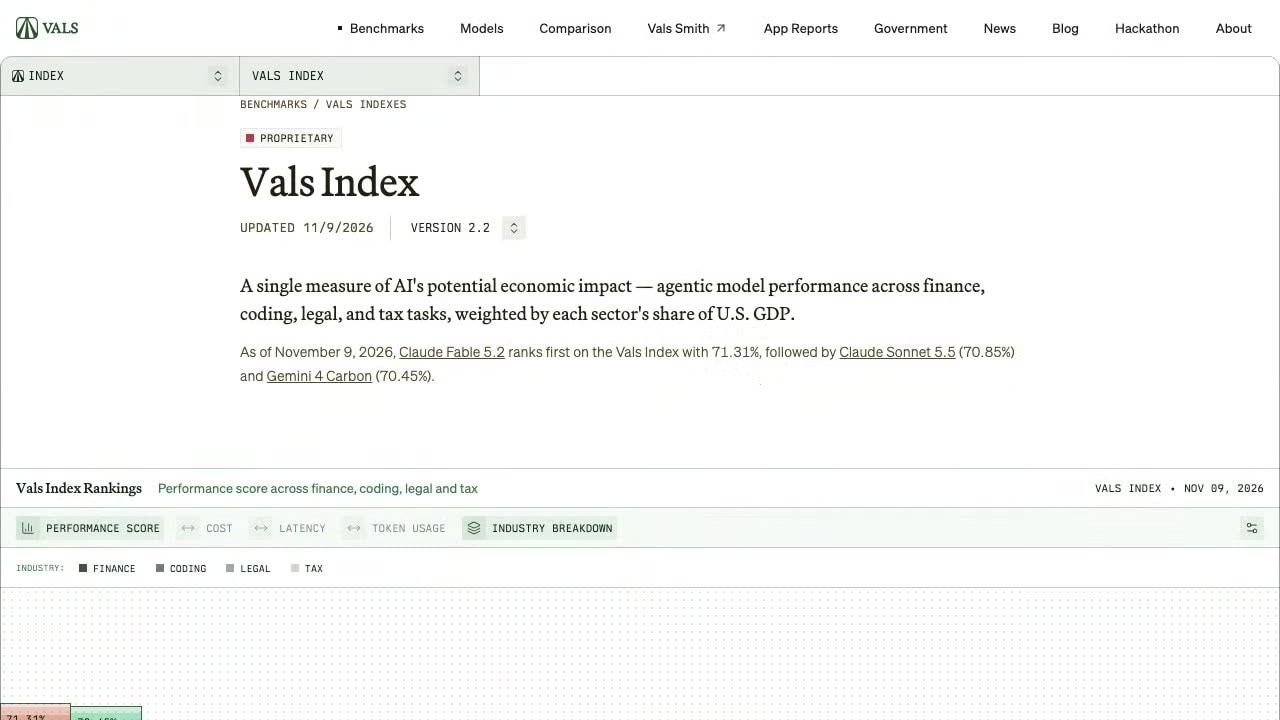
Which model leads depends on the test.
5. The real price: cost per task
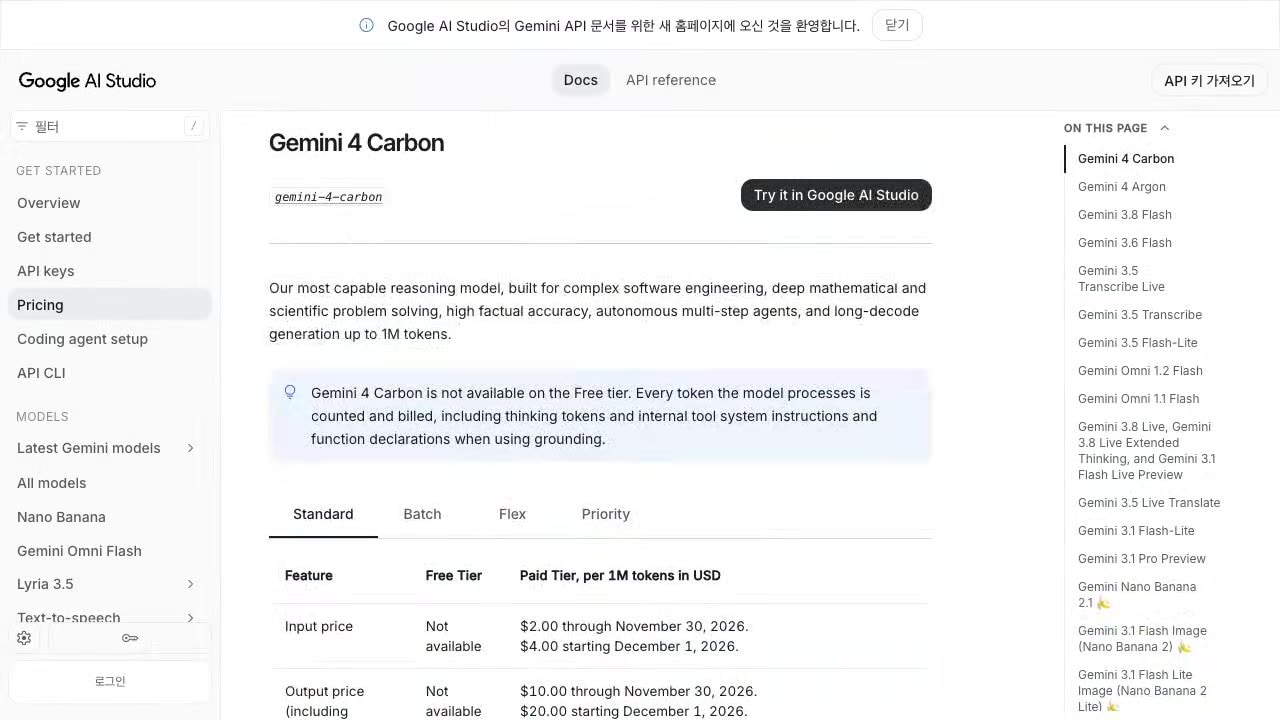
Start with the price list. Carbon costs $2 input and $10 output per million tokens. That launch price ends November 30, and from December 1 it becomes $4 and $20, exactly double [Official docs]. The December price matches Opus 5.5 and is half of Fable 5.2's $8 and $40 [Official docs].
But the list price is not what you actually pay. The money it takes to finish one job, the cost per task, is price × tokens used. A model that uses a lot of tokens can be expensive even at a low rate.
| Measurement | Carbon | Compared with | Difference |
|---|---|---|---|
| Artificial Analysis, December prices, same high setting | $7.76 | Fable 5.2 high $9.08 | about 15% cheaper |
| Artificial Analysis, December prices | $7.76 | Fable 5.2 top setting $26.54 (5 points higher) | about one third |
| Vals AI, per test | $10.51 | Fable 5.2 $17.94 | about 41% cheaper |
[Community report] The reason it is only 15% cheaper than Fable at the same setting, despite half the rate, is tokens. To run the whole Artificial Analysis index, Carbon produced about 2.8× the median output tokens of comparable models, and took about 1.5× as long, 26.1 vs 16.9 minutes.
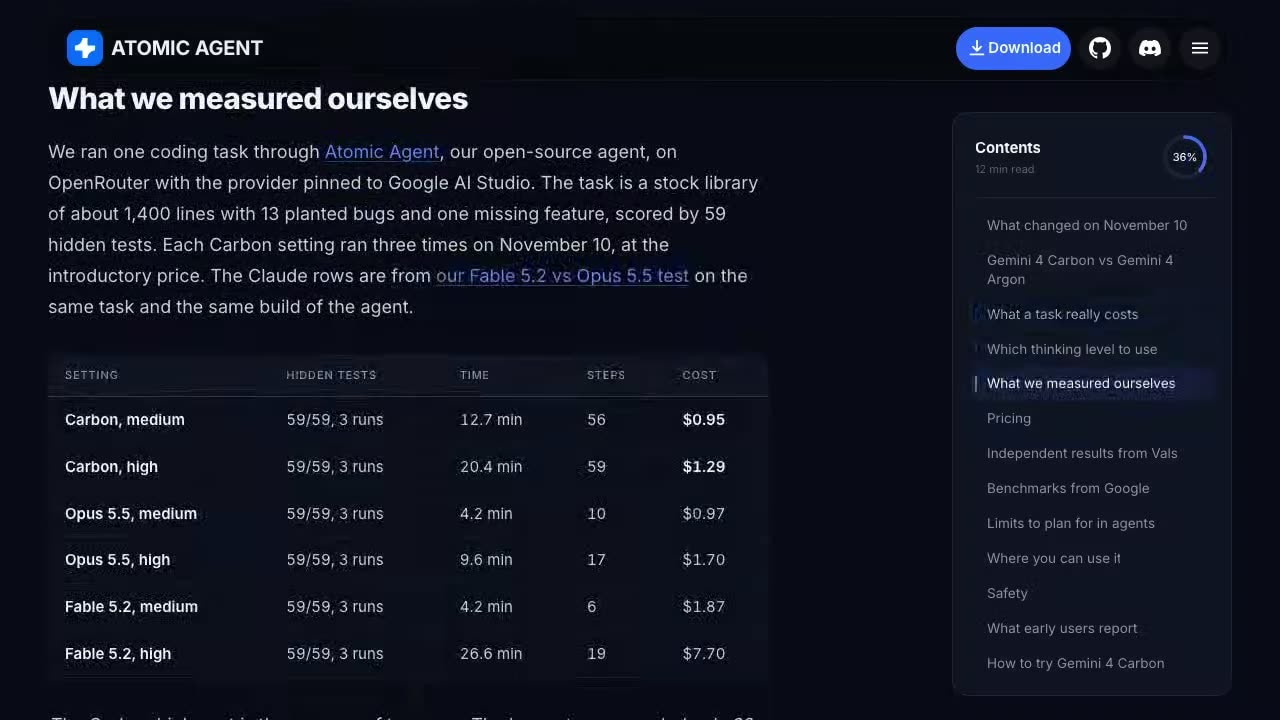
Atomic Agent measured one coding task in depth: fix 13 bugs and fill in one missing feature. All three models passed all 59 hidden tests. [Community report]
| Model (high) | Cost | Time |
|---|---|---|
| Carbon | $1.29 | about 20 min |
| Opus 5.5 | $1.70 | about 10 min |
| Fable 5.2 | $7.70 | about 27 min |
There is a catch. Carbon's cost is at the November launch price, averaged over two of three runs. At December prices it becomes about $2.60, which is more than Opus 5.5 at the same high setting.
In the end, how much cheaper it is depends on what you compare it with.
6. The weak spot: speed
- Artificial Analysis measured 66 seconds to the first answer. The median for comparable models is 12 seconds [Community report].
- The one-line bug fix from codeSTACKr above took 68 minutes vs 15 [Community report].
- On Hacker News, commenters said it is "for long tasks, not for chat," and that one "barely finished a single project on the Ultra plan" [Community report].
- Google's model card also notes that it can occasionally be slow or time out [Official docs].
7. Which plan unlocks it
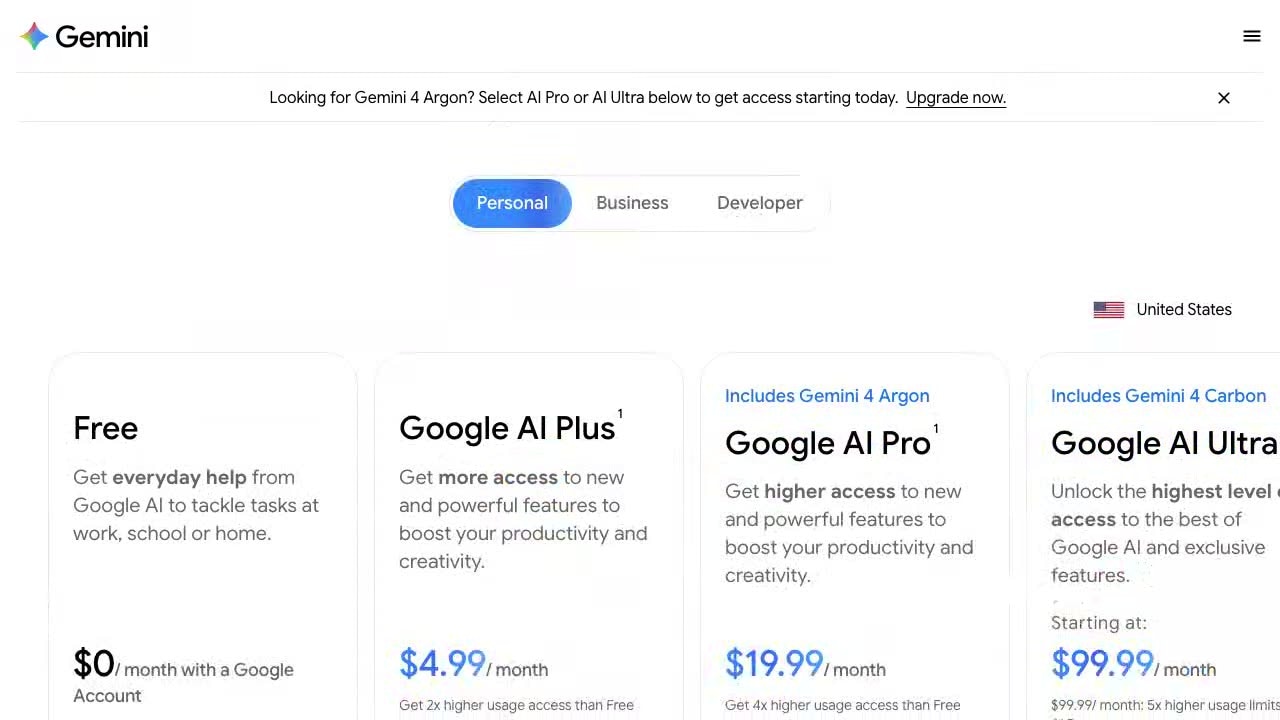
These are the US prices shown on Google's subscription page [Official docs].
| Plan | Monthly price | Carbon |
|---|---|---|
| Free | $0 | No |
| Google AI Plus | $4.99 | No |
| Google AI Pro | $19.99 | No (up to Argon) |
| Google AI Ultra | $99.99 (5× Pro limits) / $199.99 (20× limits) | Yes |
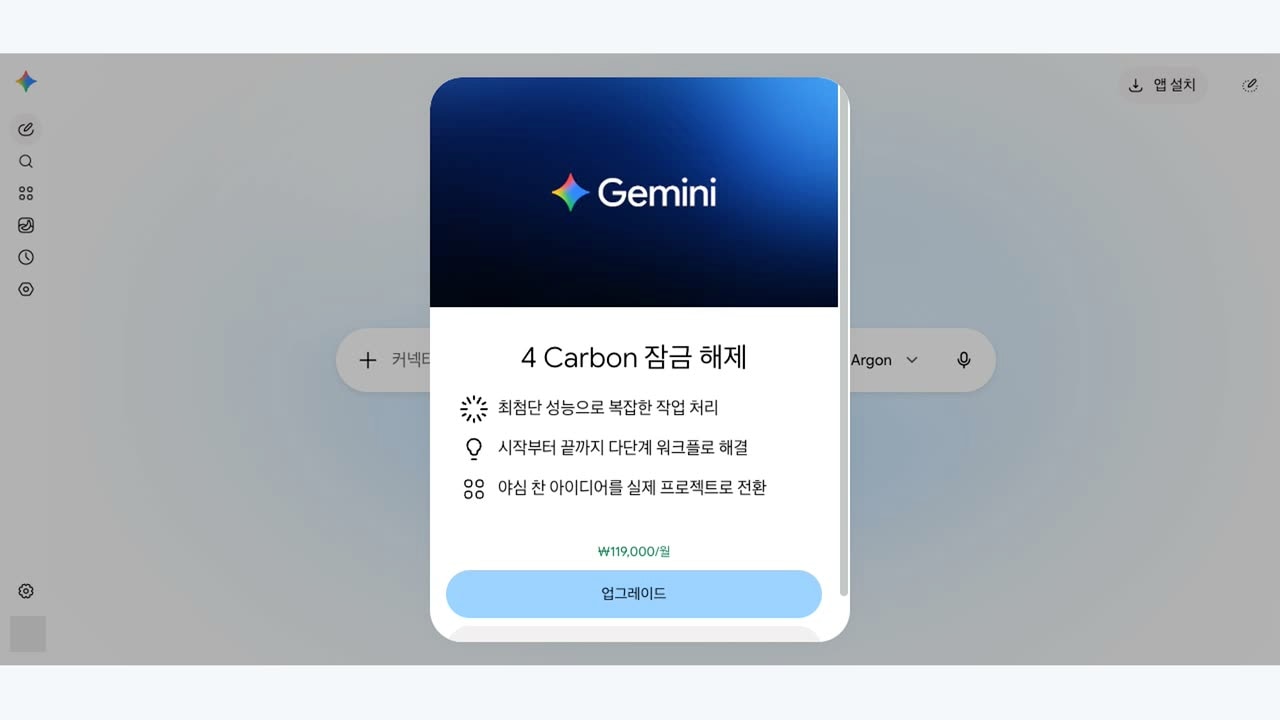
On a Pro account, picking Carbon from the model menu in the Gemini app pops up an unlock dialog, which shows ₩119,000 per month on a Korean account [Our measurement].
There are other routes besides a subscription [Official docs].
- Gemini API: no free tier; paid tier only.
- Businesses: available through Gemini for business.
- Scientists: six months free if your application is selected.
- Security defenders: you can apply to the Fairwind program.
8. How to choose, and limitations
To sum up:
- In the measurements we looked at, cost per task was lower than Fable 5.2, but by anywhere from 15% to two thirds, depending on which setting you compare against.
- Whether it beats Opus 5.5 depends on December pricing. On Atomic Agent's task, Opus 5.5 is cheaper once you switch to December prices.
- It is slow. 66 seconds to the first answer. That makes it a candidate for long tasks you leave running for hours, or for security reviews. For iterative, conversational development, Argon is the better fit, as Google itself says, and Argon is included in the Pro plan.
- If you want to try it through the API, do it in November at launch prices, but budget at December prices.
The limitations are clear, too.
- Every usage example in this post is someone else's run; we did not reproduce them under the same conditions, and most are one or two runs.
- Many performance numbers were measured by Google itself. Independent sites use different methods, so their numbers shouldn't be compared directly.
- Leaderboards keep changing. These are the values we saw on November 11, 2026; check the original pages on the day you read this.
Half the price on the price list was not half the price per task.
Watch the video
The video (in Korean) walks through the early testers' actual results, the leaderboards and the plan screens.
Sources
Google (official docs)- Google, Introducing Gemini 4 Carbon (2026-10-28) — purpose, swarm, official demos
- Google, Gemini 4 Carbon is now available (2026-11-10) — general availability, Argon recommendation, where to use it
- Google DeepMind, Gemini 4 Carbon model card — comparison table, limitations
- Google DeepMind, Gemini 4 Carbon safety and security report (PDF) — Argon evaluations carried over, honesty 70%→92%
- Google AI Studio, Gemini API pricing — November and December prices, no free tier
- Google, Gemini subscriptions — models included in each plan
- Artificial Analysis — Gemini 4 Carbon — index, cost and time per task, output tokens, time to first answer, hallucination
- Vals AI — Vals Index — overall score, cost per test
- Arena leaderboard — Text and WebDev scores
- ARC Prize leaderboard — ARC-AGI-2 and 3
- Atomic Agent — Gemini 4 Carbon — cost and time on one coding task
- Hacker News thread — user reactions
- codeSTACKr × LiveKit, Gemini 4 Carbon Built This Voice Assistant in 4.5 Hours
- Sam Witteveen, Gemini 4 Carbon is Live!
- Paul J Lipsky, Gemini 4 Carbon Is Here (Fully Tested)
- Bijan Bowen, Gemini 4 Carbon test
- Simon Willison, llm-gemini 0.36