

This post is the written version of a Korean-language video on our channel.
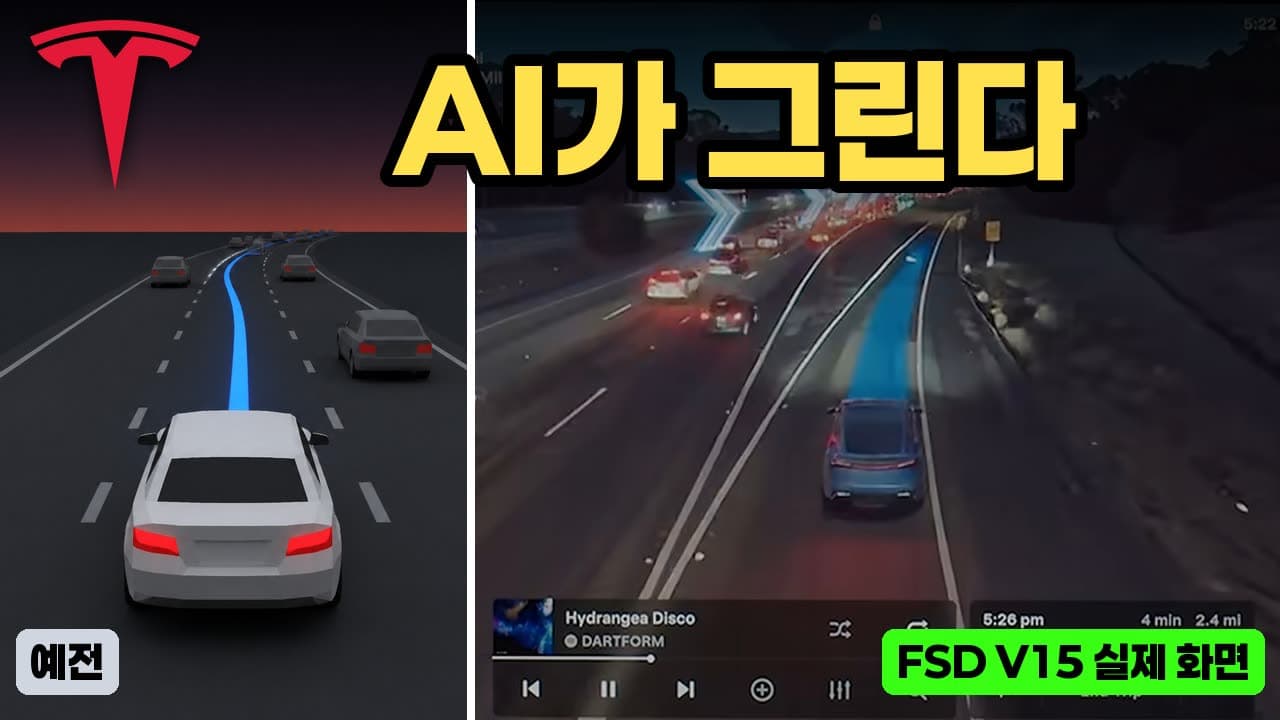
Tesla FSD V15 ships a new Reality View. At night the screen shows mall signs, shop lights and parked cars just as they look outside. In daylight, cars across several lanes, roadside trees and buildings flow by like a photo.
The old screen placed gray 3D models on a map. The new one has an AI draw the street as video, seen from a virtual camera above the car. That raises two questions: how is it drawn in real time, and how far can you trust it?
This post covers:
- FSD and the visualization screen
- The old way: detect, list, place models
- The new way: the encoder and its features
- How AI draws a picture: diffusion
- Three tricks for real time
- How accurate is it?
- Checking with a public model
- A misconception: Gaussian splatting
- How it relates to world models
How to read the numbers. [Official] means posts and talks by Tesla's official account, Elon Musk, or Tesla AI lead Ashok Elluswamy. [Report] means press coverage, such as release-note copies and test-drive reviews, that we did not reproduce. [Paper] means a public paper. [Our measurement] means values we ran on a MacBook with a public image model. Our measurements use neither Tesla's chip nor Tesla's model, so they are not Tesla performance numbers.
1. FSD and the visualization screen
FSD is Tesla's driver-assistance AI. The AI drives, but a person must always watch: it is a supervised feature, like a student driver at the wheel with an instructor in the passenger seat.
The visualization shows what the car currently sees, a thought bubble into the driver's head. V15 began rolling out on November 21, 2026, first to some cars with Tesla's fourth-generation driving computer, AI4 [Report].
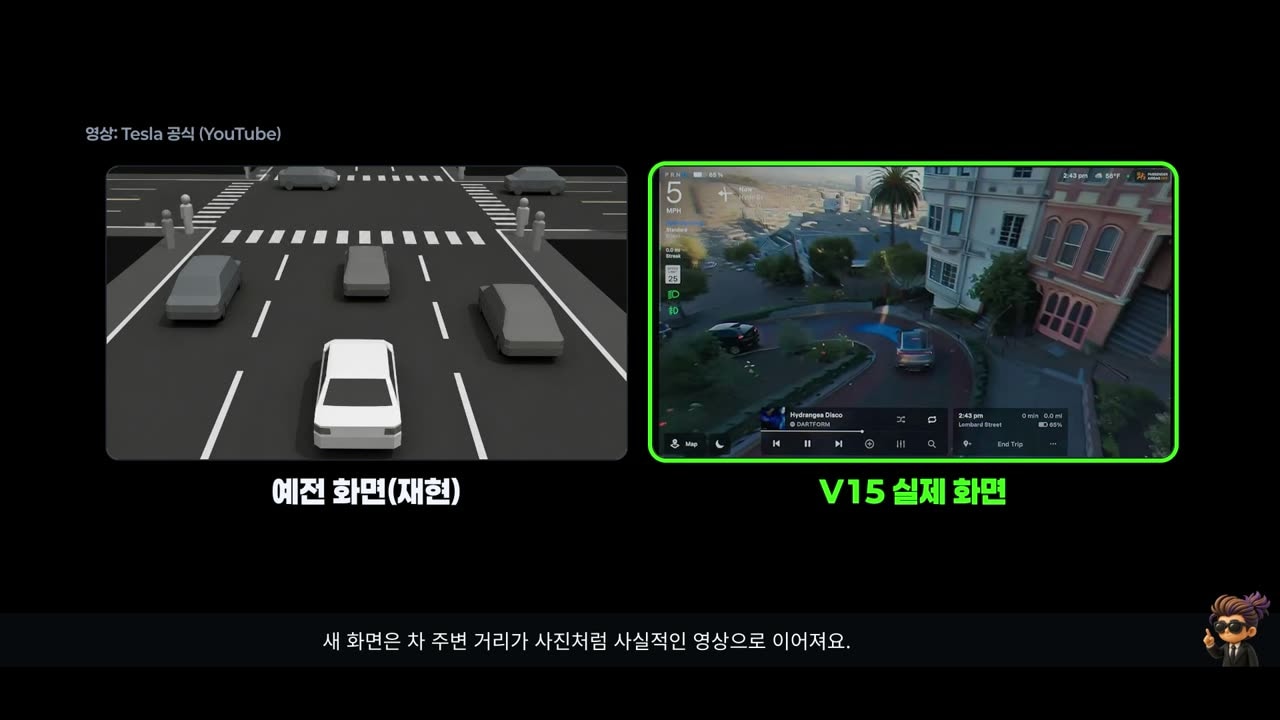
The left side is an illustration we drew to explain the old screen. The right side is the real V15 screen from Tesla's official video.
2. The old way: detect, list, place models
The old screen worked in three steps.
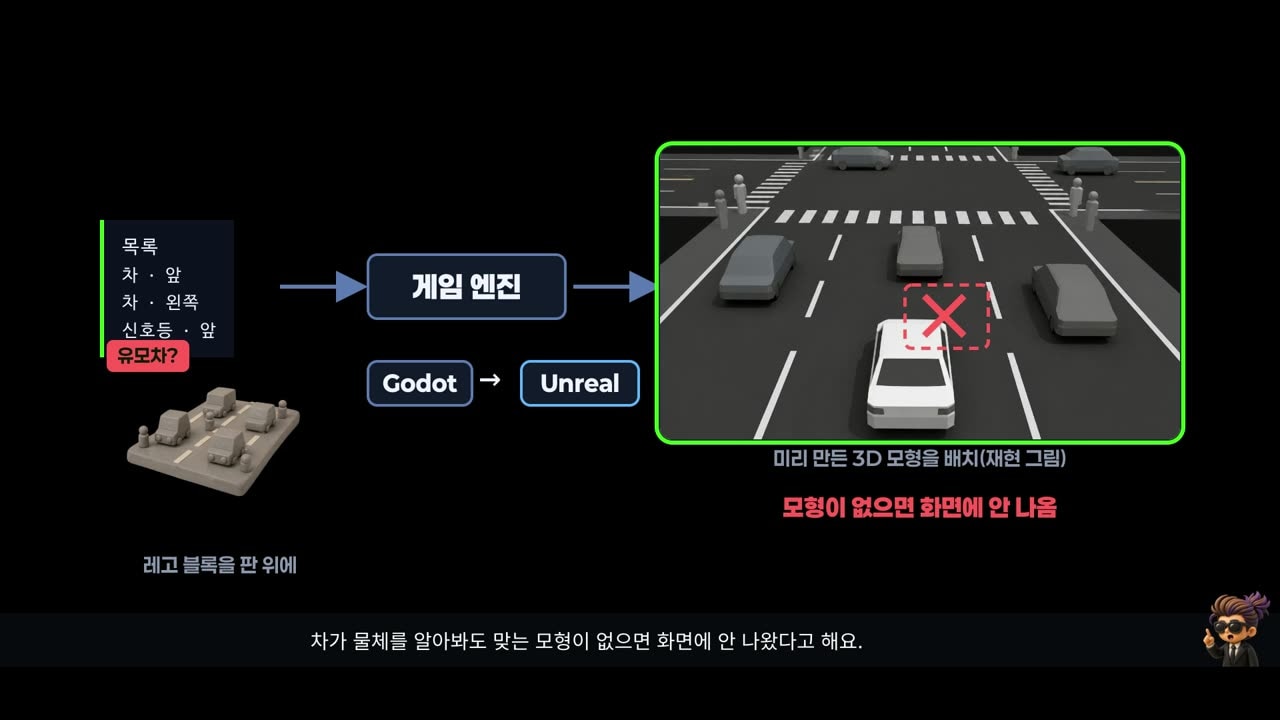
- Detection: find cars, people and lanes in the camera video, like putting a name tag on each object in a photo.
- List: up to V14, detections were organized into a list of type, position and heading [Report].
- Place models: the list went to a game engine, which placed ready-made 3D models. The engine was Godot at first and later Unreal [Report].
It is like building a scene from Lego bricks: clean, but limited. If the car detected an object with no matching model, it did not appear on screen [Report]. You cannot place a Lego piece that is not in the box.
3. The new way: the encoder and its features
The new method skips the list. It draws video directly from what the encoder saw.
- The encoder turns camera video into a summary the AI can use. It is the car's eyes, a stenographer who writes down only the key points.
- That summary is called a feature: a bundle of numbers no person can read.
- According to release-note reports, this vision encoder was trained on millions of internet videos and is shared by FSD, Robotaxi and Optimus, Tesla's humanoid robot [Report].
From here the two accounts differ slightly.
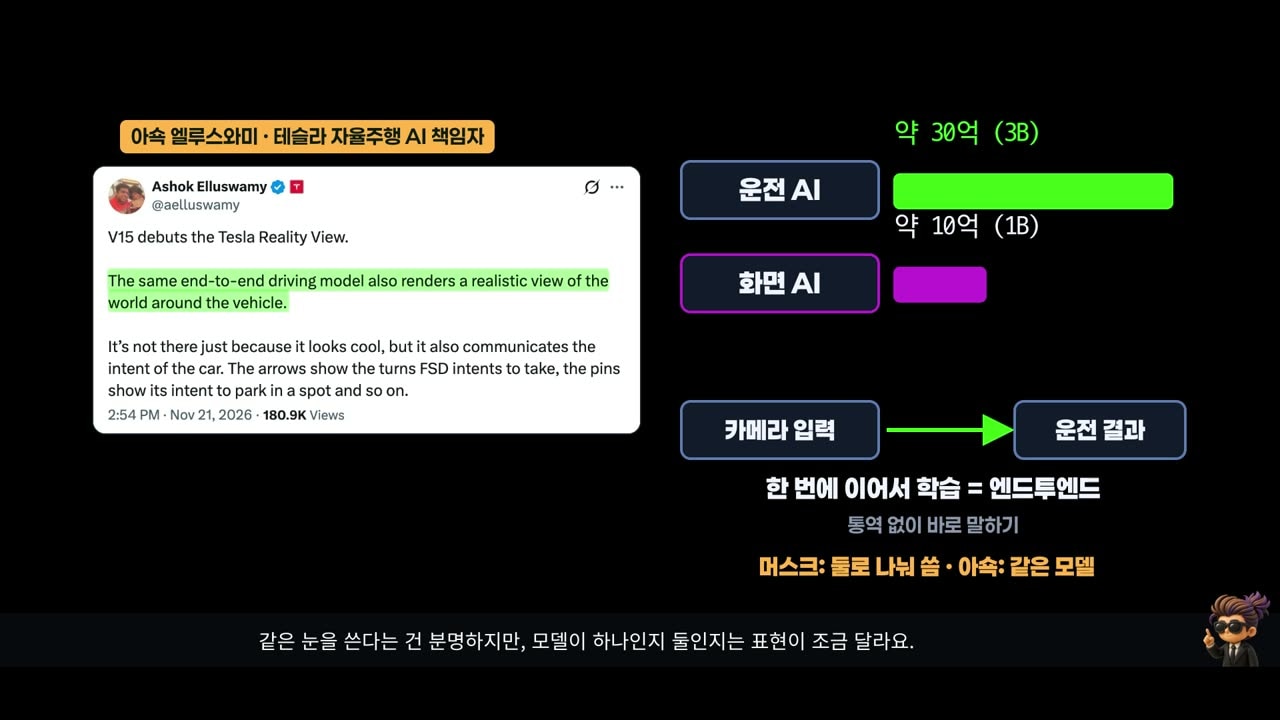
- Musk: a driving AI and a screen AI share these features. The part that outputs driving actions has about 3 billion parameters, the screen part about 1 billion [Official]. Parameters are the numbers tuned during training, roughly like connections between brain cells.
- Ashok Elluswamy (Tesla AI lead): the same end-to-end driving model also renders the screen [Official]. End-to-end means training everything from camera input to driving output in one chain.
4. How AI draws a picture: diffusion
An AI that makes new images or video is a generative model, a painter facing a blank canvas. This painter starts from noise: random dots like TV static.
Diffusion builds a picture by removing that noise little by little, like wiping a fogged window with a cloth. But the view behind the window was not there before: the AI invents it from the conditions it is given.
One wipe is a step. Ordinary diffusion needs dozens of steps to get sharp. The car screen must keep producing more than 30 frames per second, so that is too slow as is.
5. Three tricks for real time
Trick 1: one or two steps instead of dozens
In 2025, Kaiming He's group published MeanFlow to fix slow generation. Instead of many small wipes, the model learns the average direction and finishes in one or two. It is like jumping straight to the goal instead of walking 50 steps down a winding path [Paper].
- On ImageNet it reached an FID of 3.43 with a single step [Paper]. FID scores how close a batch of generated images is to a batch of real photos; lower is better.
- This is not a score for road-scene accuracy, and the paper gives no real-time speed.
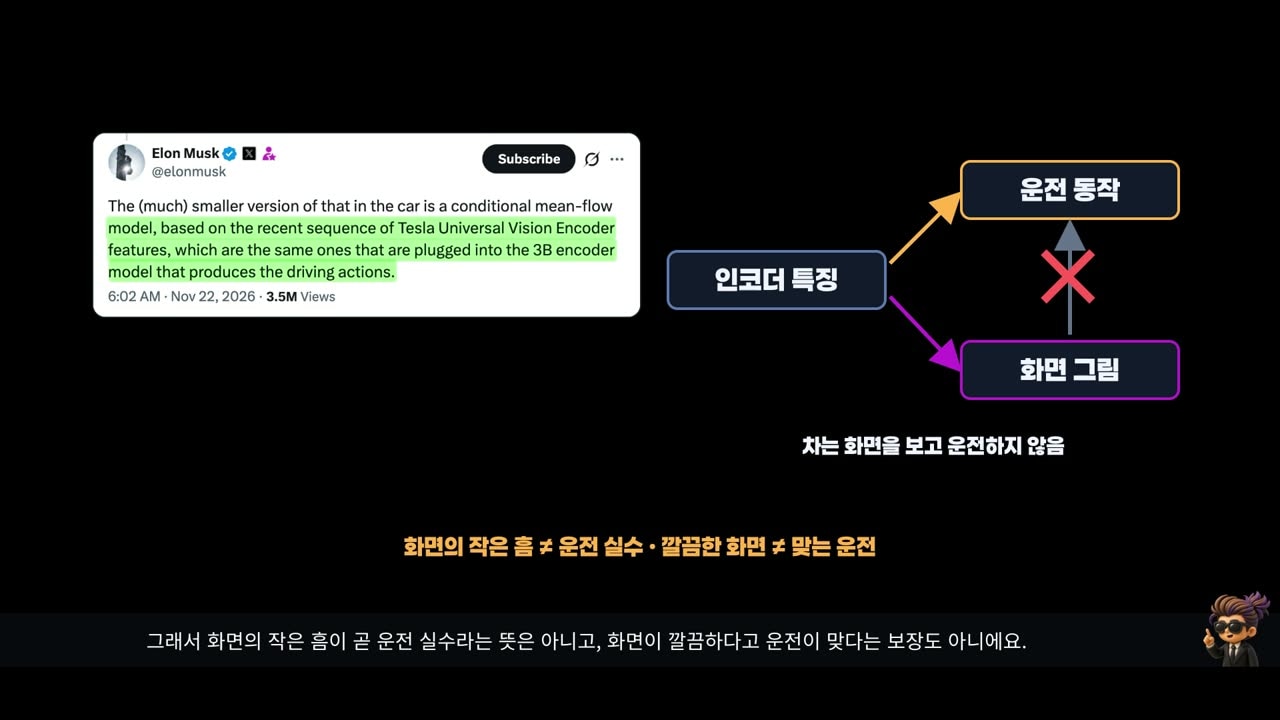
Musk described the in-car model as a conditional mean-flow model [Official]. Conditional means it draws from an order form: the features from the eyes. Tesla has not said how many steps the car actually runs.
Trick 2: repaint the last frame instead of starting blank
According to Musk, the model adds a little noise to the previous frame and refines it into the current scene [Official]. Like painting only today's changes over yesterday's picture, it has a shorter way to go than starting from blank.
A similar idea appears in Google's 2024 GameNGen, which tried to render a real-time game with AI alone, no game engine. During training it deliberately added noise to previous frames so errors would pile up less over long runs, and it rendered the classic game DOOM at 20 frames per second with 4 steps [Paper]. There is no evidence Tesla used the same method; it only shows the idea is used in public research too.
Trick 3: batch the frames and squeeze the chip
Musk gave these numbers [Official].
| Item | Detail |
|---|---|
| One batch | 8 images output at 36 fps, about 0.22 s of video |
| Encoder | Refreshes 18 times per second (18 Hz); rendering is split across 4 cycles |
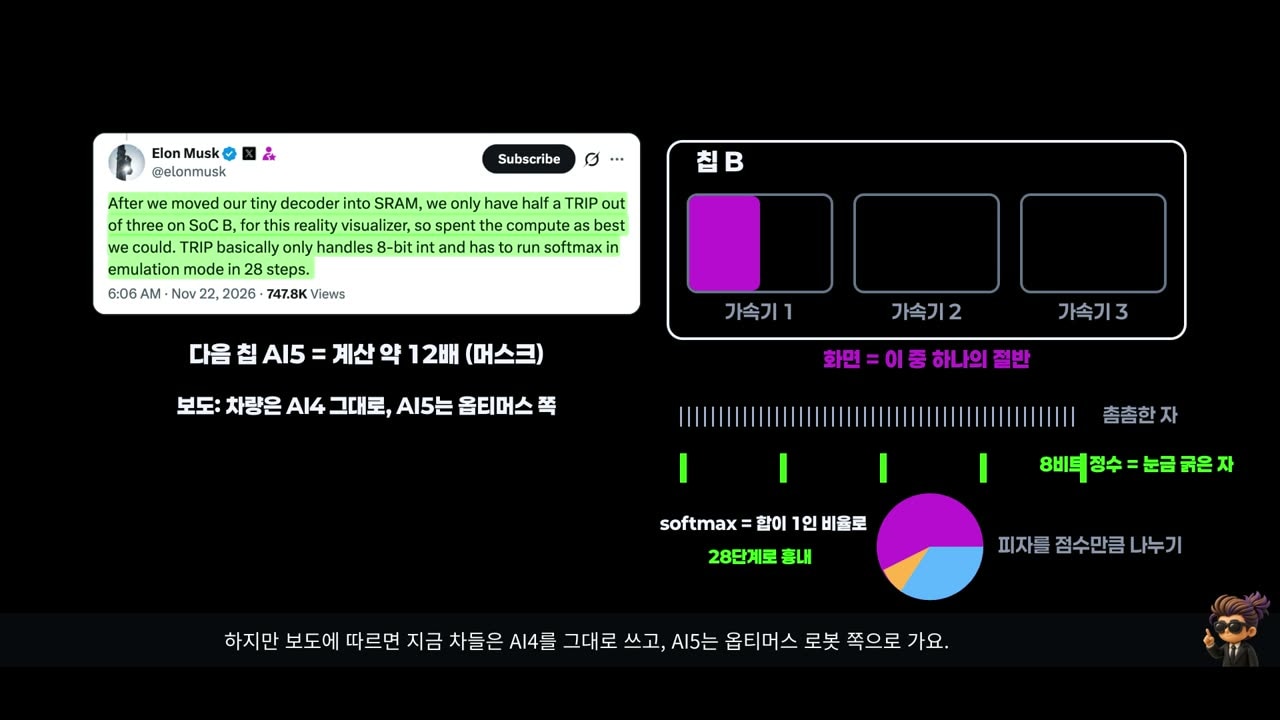
| Chip | Uses half of one of the three AI accelerators (TRIP) on SoC B |
| Math | TRIP mostly handles 8-bit integers; softmax is emulated in 28 steps |
| Decoder | A tiny decoder that turns the summary into pixels was moved into on-chip SRAM |
Softmax turns scores into proportions that sum to 1; 8-bit integers are like measuring with a ruler that has coarse marks. Musk said the next chip, AI5, has about 12x the compute [Official], but reports say current cars stay on AI4 [Report]. The screen is built by squeezing a small leftover slice of today's chip.
Ashok said the new screen uses less compute than the old one [Official]. Sharing the encoder's work between driving and the screen could explain that, but he did not give a reason.
6. How accurate is it?
The screen AI clearly looks at the same encoder as the driving AI. That alone does not guarantee that objects and markings on screen match reality.
One more point matters. The car does not drive by looking at this picture. In Musk's description, the encoder features go straight to the part that outputs driving actions, and the screen is drawn separately from the same features [Official]. So a small flaw on screen does not mean a driving mistake, and a clean screen does not guarantee correct driving.
Tesla introduced the screen as a way to see and control what FSD is planning to do. Ashok also said it is not decoration but a way to show the car's intent: arrows show turns, pins show where it intends to park [Official].
Two limits typical of generative models remain.
- Filling in: reviewers point out that areas the cameras did not see get plausibly filled in, which makes it hard to verify markings such as crosswalks [Report].
- Latency: test-drive reports say the screen lags the window by a fraction of a second and turns its view slowly [Report]. Musk agreed latency is a bit high for now because of compute limits, and said interleaving the newest encoder features into the middle layers of the renderer could cut latency by about 35% [Official]. Nothing says that is in cars yet.
7. Checking with a public model
We ran a public image model to see what step count and repainting change [Our measurement].
- Setup: Apple Silicon MacBook (MPS), Stable Diffusion 1.5, LCM-LoRA for few steps, 512×512
- Note: neither Tesla's chip nor Tesla's model, so these are not Tesla numbers.
Step count
| Method | Time per image | Result |
|---|---|---|
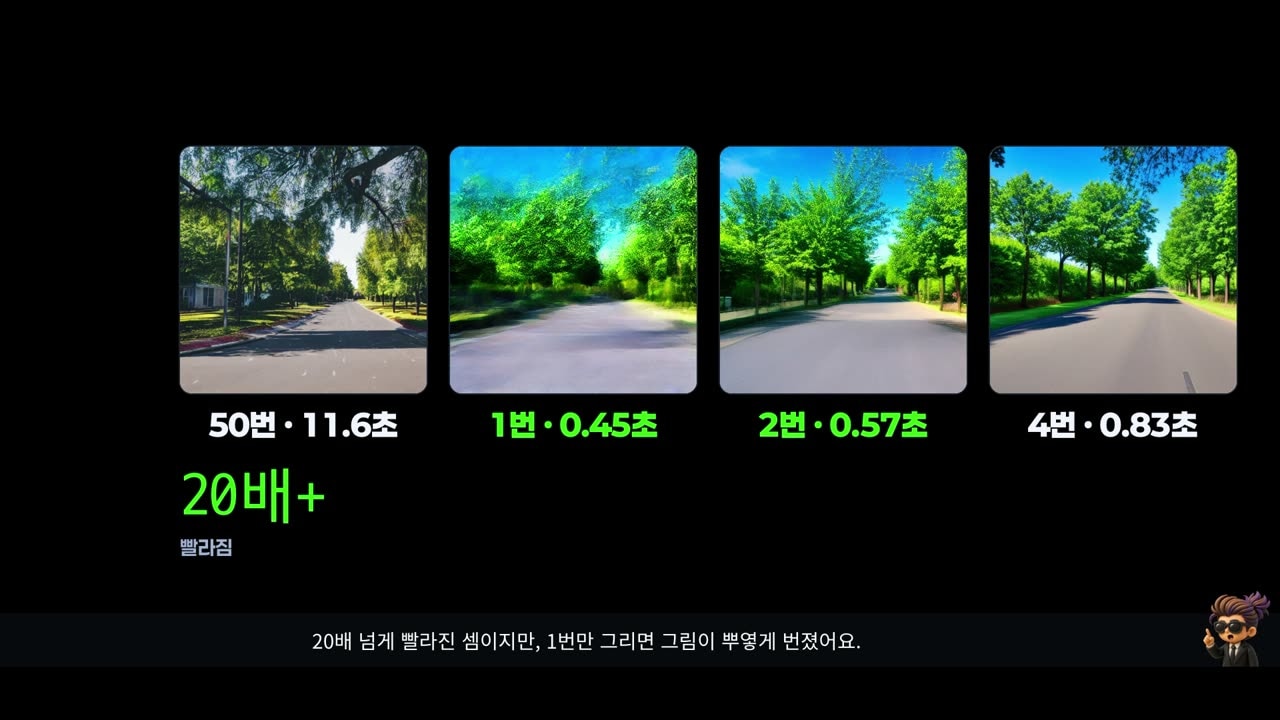
| Base model, 50 steps | about 11.6 s | reference |
| LCM, 1 step | 0.45 s | blurry |
| LCM, 2 steps | 0.57 s | a street close to the 50-step one |
| LCM, 4 steps | 0.83 s | a street close to the 50-step one |
The version trained to finish in few steps was more than 20x faster. One step was blurry; from two steps on it was usable.
Repainting the previous frame
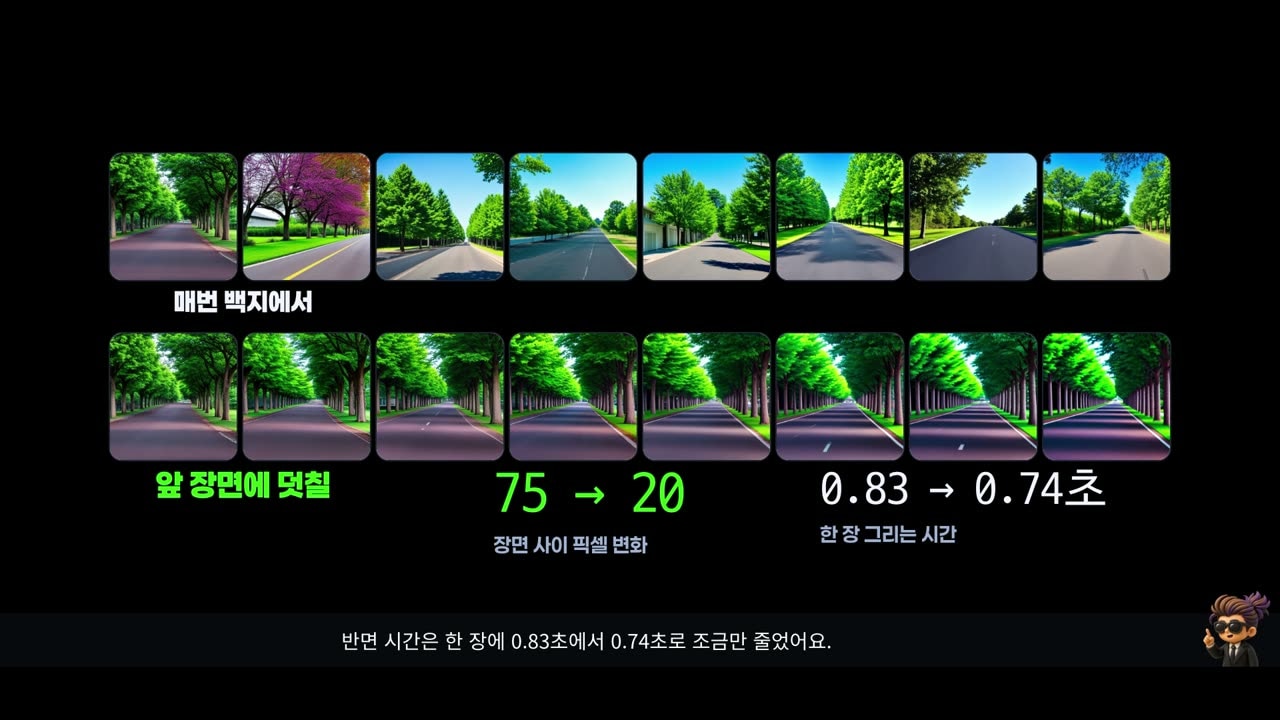
We drew 8 frames in a row, imitating a car moving forward.
| Method | Pixel change between frames | Time per image |
|---|---|---|
| Blank each time (4 steps) | 75 | 0.83 s |
| Repaint previous frame with half noise (2 steps) | 20 | 0.74 s |
Starting blank every time, tree colors and road shapes changed completely between frames. Repainting kept the same street flowing naturally, and frame-to-frame change dropped to about a quarter. Time dropped only a little. In this test, the big win from repainting was a stable picture, not speed.
Repainting again and again, though, made colors grow darker over time. Adding noise during training, as GameNGen did, is meant to reduce exactly this kind of buildup.
8. A misconception: Gaussian splatting
Many posts claimed Reality View is rendered with Gaussian splatting, which builds a 3D scene from millions of translucent colored blobs scattered in space.
We found no evidence of that in what Musk and Tesla have published. Musk said the AI generates the video [Official].
The idea seems to come from Ashok's conference talk. In his CVPR 2026 autonomous driving workshop keynote, he showed Tesla's generative Gaussian splatting. But he presented it as one of several outputs the driving model produces alongside its actions, a 3D output to check and debug the system's decisions [Official]. He did not link it to Reality View.
9. How it relates to world models
Musk said Tesla has used a near pixel-perfect world model for synthetic training data (data made by computer instead of filmed) since last year. A world model is an AI that renders, as video, how the world will change next. Musk described the in-car Reality View as a much smaller version of that world model [Official].
The jobs differ, though. A training world model imagines what comes next; the in-car screen shows the scene it just saw. No published statement says this screen predicts the future for driving.
Summary
- Instead of placing models from an object list, it draws video directly from the features the eyes (encoder) produce.
- Few steps, repainting the last frame and batching make it real time.
- It shares the driver's eyes, but the car does not drive from the screen, and filled-in areas and latency remain.
Watch the video
The scene diagrams and real driving footage are in the video (Korean).
Sources
- Tesla official video "Introducing Tesla Self-Driving V15": https://www.youtube.com/watch?v=eNBqkc7V1nU
- Tesla announcement: https://x.com/Tesla/status/2124222447855743019
- Musk (model structure and size, 18 Hz, 8 frames at 36 fps, TRIP, latency): https://x.com/elonmusk/status/2124458557525397780 · https://x.com/elonmusk/status/2124459444620628193 · https://x.com/elonmusk/status/2124270426402836626
- Ashok Elluswamy: https://x.com/aelluswamy/status/2124229978560835880 · https://x.com/aelluswamy/status/2124230700547326435
- Ashok Elluswamy, CVPR 2026 keynote (WAD workshop, around 16:10): https://www.youtube.com/watch?v=2V0ddkF1Svo&t=970
- FSD V15 release notes: https://www.notateslaapp.com/software-updates/version/2026.38.6.11/release-notes
- Rollout report: https://electrek.co/2026/11/21/tesla-fsd-v15-rollout-25x-safety-reality-view/
- How Reality View works and its limits: https://www.notateslaapp.com/news/5068/how-teslas-fsd-v15-reality-view-actually-works-video
- Latency report: https://www.teslarati.com/tesla-fsd-v15s-reality-drive-one-complaint-musk-solution/
- AI4 stays, AI5 report: https://www.teslarati.com/tesla-starlink-built-in-ai5/
- Old visualization (Unreal) report: https://www.notateslaapp.com/news/3008/tesla-to-switch-to-unreal-engine-for-improved-fsd-visualizationsk
- MeanFlow paper (Geng et al., 2025): https://arxiv.org/abs/2505.13447
- GameNGen paper (Valevski et al., 2024): https://arxiv.org/abs/2408.14837
- Real driving footage (used in the video): Sawyer Merritt https://www.youtube.com/watch?v=TSpBfh7Ubw8 · https://www.youtube.com/watch?v=swuHnUDS6hM